


In the fall of 1952, Rochel Pinson wanted nothing more than a quiet, ordinary life.
Born in the Soviet Union just a few years after the Bolshevik Revolution, from her earliest years her world had been anything but ordinary: a string of narrow escapes, upheavals, and acts of self-sacrifice—including the arrest and execution of her father—simply to remain faithful to a Jewish way of life. A few months after her marrying her husband, Rabbi Nissan Pinson, the young couple fled the Soviet Union. They made it to Paris, where they set about building a new life, hoping still to secure American visas so they could settle in New York once and for all.
Then came an unexpected request.
The Rebbe, Rabbi Menachem M. Schneerson, of righteous memory, who had only recently assumed leadership of the Chabad-Lubavitch movement, asked Rabbi Pinson to travel to Morocco to assist two Chabad rabbis who had previously been sent to the North African country to serve the local Jewish community. When it became clear that the work would require a long-term commitment, the Rebbe asked Rochel and the children to join him.
“I didn’t want to go!” Rebbetzin Pinson said emphatically in an interview decades later, entirely unapologetic about her reluctance to leave Paris. “I had just spent years in the Soviet Union, in Samarkand. I didn’t want to go to a primitive place. I imagined camels and deserts!”
Then she received a personal letter from the Rebbe. He assured her the position could be temporary, just to try it, and wrote that they would see that it would ultimately be for their own good. He concluded with warm blessings for her and her family.
“She said that anyone who received such blessings from the Rebbe would drop everything and go,” recalled Chassidic historian Rabbi Nison Ruppo, who interviewed her on several occasions. “Certainly she, who had grown up in a home infused with devotion to the mission of the Rebbes. So she went, and she went happily.”

While Chabad’s trailblazing work across Morocco continued to grow, it soon became clear that the nearby Jewish community in Tunisia was in need of help. After seven years of work in Casablanca, the Pinsons picked up and, with the Rebbe’s blessings, moved to Tunis, where they would serve for decades. Rabbi Pinson passed away in 2007 at the age of 89. Even after her husband’s passing, Rebbetzin Pinson continued overseeing educational and outreach activities in Tunisia, whether on the ground or from abroad. She remained active past her 100th birthday, at the time of her passing holding the distinction of being the oldest Chabad emissary.
Rebbetzin Pinson passed away on Feb. 3 (16 Shevat) at the age of 102, just hours before the start of the International Conference of Chabad-Lubavitch Women Emissaries, where thousands of women who have since followed in her footsteps were gathering for a weekend of inspiration and strength.
“When I heard the news, I cried as if my own mother had passed away,” said Rabbi Binyamin Batu Hattab, rabbi of the Grande Synagogue and director of Yeshivah Oholei Yosef Yitzchak Lubavitch in Tunis, who worked under the Pinsons for nearly half a century. “The entire community is in shock. We owe her an immeasurable debt of gratitude. She cared for us like her own children, perhaps even more.”

Behind the Iron Curtain
Born in Leningrad in 1924, Rochel absorbed an ironclad devotion to Judaism, and to every fellow Jew, from her earliest days.
Her father, Rabbi Yitzchok Raskin, was an alumnus of the original Chabad Tomchei Tmimim yeshivah in the Russian village of Lubavitch. After the Soviet takeover, he and his wife, Tzivia, became deeply involved in what the authorities labeled “counterrevolutionary” activity, namely, teaching and sustaining Jewish life under a regime determined to extinguish it.
Officially, Rabbi Raskin worked as a shochet, a ritual slaughterer, already a dangerous role under a government that persecuted religious figures. But his efforts extended far beyond that. He raised funds for underground academies, ensuring that Jewish religious schools continued operating in secret. He also took responsibility for maintaining the local mikvah, even though it, too, had been outlawed under Soviet law.
The Raskin home became a hub for Chabad’s underground activity in Leningrad. Guests were a constant presence, including prominent Chassidic figures who were high on the Soviet secret police’s watch list for being “Schneersonists,” followers of the Sixth Rebbe, Rabbi Yosef Yitzchok Schneersohn.
“She grew up with Chassidim constantly coming and going at a time when that was anything but normal,” recalls her grandson, Rabbi Levi Matusof, who frequently visited her in Tunisia and today serves as Chabad emissary in the European Institutions. “As a girl, more often than not she slept in the living room because her bed had been given to a guest.”
“We were like the Jews at the time of the Syrian-Greeks before the story of Chanukah,” Rebbetzin Pinson herself recalled in a 2010 interview. “Everything the Greeks had forbidden Jews to practice — circumcision, kosher, keeping Shabbat, Torah study — were also forbidden in the Soviet Union. But my parents and others had vowed that nothing would keep them from practicing Torah and mitzvos.”
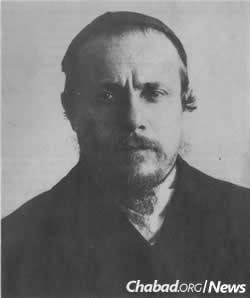
This included hiding Rabbi Elchonon Morozov, secretary to the Sixth Rebbe and a wanted man, together with his wife and three children in their house, for seven years.
The pounding on the door came in February 1938, the unmistakable signal that the Soviet secret police had arrived. In a sweeping night purge, 90 Chassidim were arrested on a single night, including Rabbi Raskin and Rabbi Morozov.
As he was led away, fully aware that imprisonment, brutal interrogations, hard labor, or execution likely awaited him, Rabbi Raskin had the presence of mind to turn to his daughters and say, “Fulfill all of G‑d’s commandments. Never forget why I was taken!”
They never saw him again.
Decades later, they learned that the arrested Chassidim had been subjected to perfunctory trials and shot in a forest outside of Leningrad within weeks.
Three years later, in 1941, Nazi Germany invaded the Soviet Union, turning on its former ally. As German forces advanced toward Leningrad, Tzivia managed to secure four precious train tickets. Tzivia, her mother, Rochel, and her younger sister fled eastward. Their two married sisters escaped separately with their husbands.
They arrived in the Soviet Kazakh city of Karaganda just before Pesach, spared from the Nazi onslaught, but not from the grinding hunger that plagued wartime Soviet life. “That first Pesach was very hard,” Rochel later recalled. “We had almost nothing to eat, just a few potatoes and beets.”
The harsh conditions proved too much for her elderly grandmother, who was 85 and passed away that year. Then, in 1943, tragedy struck again: Rochel’s mother died suddenly of a heart attack. Rochel was just 15.

Orphaned and displaced, Rochel and her sister relocated to Samarkand, Soviet Uzbekistan, where a growing Jewish population, and a particularly strong Chabad Chassidic presence, had taken root, including one of their married sisters. With the war ongoing and Uzbekistan geographically distant from Moscow’s center of power, religious persecution there was somewhat less severe.
In 1946, Rochel was introduced to Rabbi Nissan Pinson, a young man from Kharkov, Ukraine, who had studied in the underground yeshivot there and in several other locations. Like Rochel’s father, his father had been arrested by the Soviets for so-called counterrevolutionary activities. He had been sentenced to hard labor in Siberia, where he ultimately perished.
Rochel and Nissan married that same year and soon began searching for a way out of the suffocating Soviet regime. Their opportunity came amid the chaos following World War II. In a limited repatriation effort, the Soviets briefly allowed Polish citizens to return home. Many Chabad Chassidim seized the narrow opening. Through forged documents and by assuming the identities of deceased Polish citizens, they managed to slip past Soviet authorities and escape to the West.
The Pinsons made their way to the displaced persons camp in Pocking, Germany, where a significant number of Chabad families had regrouped. Among them was Rebbetzin Chana Schneerson, the Rebbe’s mother.
After a period in Pocking, the Pinsons continued on to Paris, eventually settling in the suburb of Brunoy alongside other Chabad families. They hoped to secure visas to New York and begin life anew. During their time in France, their first two children were born.

From France to Morocco
In the late 1940s, the Sixth Rebbe, Rabbi Yosef Yitzchok Schneersohn, began laying the groundwork for a bold initiative: to revitalize Torah life and Jewish observance across North Africa. The plan was still taking shape when he passed away in 1950. It was immediately taken up by his son-in-law and successor, the Rebbe, Rabbi Menachem M. Schneerson.
Just days after the Sixth Rebbe’s passing, while the Chabad world was still reeling in grief, the Rebbe sent a letter to Paris, asking Rabbi Michoel Lipsker to travel to Morocco and serve as a Chabad emissary in Meknes. Rabbi Lipsker was soon joined by Rabbi Shlomo Matusof, who directed the Chabad institutions in Morocco, and in 1953 Rabbi Nissan Pinson arrived as well. When it became clear that the work would require a long-term commitment, Rochel and the children joined him.
In Casablanca, the Pinsons and their fellow emissaries immediately immersed themselves in building yeshivot, strengthening Jewish education, and revitalizing communal life. Rebbetzin Pinson later recalled that she was pleasantly surprised to find that North Africa was nowhere near as backwards as she had feared.
“We were very well received by the Jewish community,” she said. “We became involved very quickly.”
By 1959, with the work in Morocco firmly established, the Rebbe asked the Pinsons to relocate once again, this time to Tunisia.

Tunisia’s Jewish community dated back to the destruction of the Second Temple. While Djerba was home to an ancient observant Jewish community, the spiritual infrastructure in the capital city of Tunis had by the mid-20th century weakened and was in need of renewal. Chabad had already been involved in supporting the local community for several years, but a full-time presence was needed to really change the tide.
“When we arrived in Tunis,” Rebbetzin. Pinson recalled, “it truly was a desert in terms of Judaism. There was no strong Torah education. The chief rabbi of Tunisia was very grateful that we had come to help.”
The new mission came with significant challenges. Tunisian authorities viewed the Pinsons with suspicion, and also encountered something entirely unexpected: cultural distance within the Jewish community itself. Many in the local Sephardic community had never encountered Ashkenazi Jews or their customs.
“Some of them had a hard time believing I was even Jewish,” Rebbetzin Pinson recalled with a laugh decades later. “The women would say to me, ‘You mean you don’t cook couscous boulettes [couscous with meatballs] for Friday night? Then how can you be Jewish?’”
But they persisted.
The Pinsons began strengthening existing communal institutions and building others from the ground up. Before their arrival, there was no formal Jewish school system; families would band together to hire private Judaics teachers for their children. Working closely with the country’s rabbinic leadership, the Pinsons developed a structured curriculum and secured buildings to establish a proper school network.

They began with just 33 students. Over time, enrollment grew to more than ten times that number. Alongside the schools, they strengthened and rebuilt other essential communal institutions, including mikvahs and kosher infrastructure. Even matzah baking became a full-scale local effort; importing matzah from Israel was not an option, so they ensured the community could produce its own.
“Rebbetzin Pinson drew women in and involved them in meaningful programming connected to the school,” Rabbi Binyamin Batu Hattab recalls. “She instilled yirat Shamayim, fear of Heaven, and genuinely cared for the girls and young women, guiding them personally.
“And not only the women, the children as well. She would walk into classrooms and teach them how to recite blessings, how to sing Hebrew songs, how to pray, the morning blessings, Mincha in the afternoon. She cared for them with the warmth and devotion of a mother. Not like a rebbetzin, but like a mother.”
The decades in Tunisia were not without danger. The Pinsons lived through anti-Jewish riots following the Six-Day War, the tragic 1971 murder of a revered local rabbi, Chacham Matzliach Mazouz, and the unsettling period when Yasser Arafat’s Palestine Liberation Organization terror group relocated to Tunisia after being expelled from Beirut: The PLO’s new headquarters was opened right next door to the Pinsons’ Jewish school.
A steady exodus of Jews followed, as many sought safer shores. At one point, the Mossad explored ways to evacuate the remaining community. But the Pinsons stayed, encouraged by the Rebbe’s reassurances that all would ultimately be well.

In 2007, Rabbi Pinson passed away. Rebbetzin Pinson, however, did not retire from her mission. For a time she remained in Tunisia, continuing her work to ensure the community’s Jewish education and religious needs were upheld. She later relocated to France to live near her children, but she continued traveling back to Tunisia and remained closely involved in the community’s affairs.
“She came to Tunis many times,” Rabbi Hattab says. “And even when she wasn’t physically here, we were in constant contact by phone. She would ask about everything — the situation, the students’ wellbeing, their studies, the programs. Everything.
“Even when she was far away, she was with us in her heart and in her thoughts. She took an interest in every single detail of what was happening in the school.”
Since Rebbetzin Pinson first set out to Morocco, thousands of Chabad rebbetzins have followed in her footsteps, traveling to communities across the globe to build and revitalize Jewish life.

Each year, they gather for the International Conference of Chabad Women Emissaries, a powerful reunion of women serving on the front lines of Jewish continuity. In recent years, Rebbetzin Pinson, as the oldest woman among them, was honored and celebrated at many of these gatherings. Her passing coincided with the opening of this year’s conference, a striking and fitting bookend to a life that helped define what that gathering represents.
“She lived her entire life devoted to helping every fellow Jew,” Rabbi Matusof says. “That is the path she helped forge, and it is a lesson all of us can carry forward.”
Rebbetzin Pinson is survived by her children: Rabbi Yossef Yitschok Pinson, director of Habad Loubavitch of Nice Côte d'Azur, France; Faige Hecht, a Chabad-Lubavitch emissary in Nice, France; Tscherna Matusof, Director of the Jewish School of Cannes, France; Rabbi Nachum Pinson, senior teacher in Beth Rivkah girls seminary in Yerres and Mashpia in the Chabad Yeshiva in Brunoy, France; Rabbi Shmuel Pinson, co-director of Ohel Menachem in Brussels, Belgium; many grandchildren, great-grandchildren and great-great-grandchildren.


It does my heart good, with all the darkness in the world, Hasham would bless us with this Angel,
May her inspiration and love of her people welcome our new holy beginning for eternity,
With great love and warmth,
Stephen J. Brody
Long Island, NY