|

Chabad of Port Washington Email: [email protected] Voice: 516-767-8672 www.ChabadPW.org

|
|
|
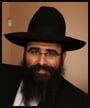
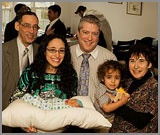
Our community will be celebrating Gideon Clontz's 3rd birthday this Shabbos, which traditionally is when the first haircutting takes place (obviously not on Shabbos) and Jewish education begins in earnest.
Most cultures think of education as something that begins much later on. Judaism says start 'em young!
It's like the cherubs on the Temple's Holy Ark (discussed in this week's Torah Portion). They were golden statues with the image of children, which hovered over the Ark. Torah calls for these cherubs to be carved out of one single chunk of gold as the Ark's covering itself, rather than being created separately and then attached to the Ark.
The lesson: If we want our children to walk the path of the "Ark"(=the Torah and the 10 Commandments) we need them to realize their relationship to the "Ark" isn't an "addition" to who they are as a person; their very souls are 'carved' out of the Ark; they are ONE with TORAH, Jewishness and HASHEM. Right from the start.
How do we make this message come alive in our kids?
A proper "golden" Jewish education (even if it sometimes is as expensive as it is priceless)...
A Jewish Day School education gives a child a clear identity, a sense of who he or she is in the world, which makes for a happier, more secure child, and ultimately a more successful one. Raising children in today's culture of "anything goes" where nothing is really right or wrong anymore, a strong Jewish foundation is more important than ever, for the child's mental, emotional and spiritual wellbeing as he or she navigates the ever choppy waters of modern life. (Like any private school, Jewish day school is expensive. But I'd venture to say the cost will more than be offset by what we'll likely save on therapy and other intervention later on.)
As our son Ephraim said to Sara and I after his first week in YESHIVA (age 5): "I'm learning so much at Yeshiva. I know it's expensive, but it's worth every penny..."
From the mouth of babes.
Shabbat Shalom,
Rabbi Shalom M Paltiel
P.S. We need Kiddush sponsors for the next two Shabbats, leading up to Passover. No need to spend a lot of gelt, for $150 we'll have hot cholent and some salads to go with the L'chayims. Let me know if you can help out with one of these. For this Shabbos we have a nice Kiddush thanks to our sponsors listed on right. Join us for our monthly FARBRENGEN taking place this Shabbos after lunch and mincha.
|
|
|

Lion of Judah - about the life of holocaust survivor Leibel Zisman, our guest speaker for Holocaust Remembrance Shabbat, April 12-13; details to follow.
Click here to watch.
|
|
|

Living with Integrity: Sunday, 10 AM
Lesson 6 | Commitments
Your friend is depending on your investment to get his business up and running. You agreed to help your friend move. You made a large pledge, but circumstances have since changed. Just how binding are your commitments? When is it all right to renege?
Click here for more info and to register. |
|
|

Parenting Class | Wednesday, 10:45 AM
Monthly parenting class lead by Sara Paltiel of Chabad Port Washington.
Click here for more info. Please RSVP by calling the office 516 767 8672.
|
|
|

Passover at Chabad
First Seder: Monday, March 25, 7:30 PM
following services at 6:45 pm
Second Seder: Tuesday, March 26, 7:30 PM
following services at 6:45 pm
Click here for more info and to register. |
|
|
Curious Tales of the Talmud: Finding Personal Meaning in the Legends of our Sages | A new JLI course
Everyone loves a good story. Knowing this, the sages of the Talmud used stories to encode messages about life that are far too deep and profound to communicate directly. This course decodes some of these extraordinary Talmudic mysteries to uncover layer within layer of insight into the nature of life, the universe, G‑d, and man.
6 Sundays, Beginning Sunday, April 21 | 10:00-11:30am At Chabad of Port Washington, 80 Shore Road, PW
Instructor: Rabbi Shalom Paltiel
Fee -includes textbooks and bagel brunch
Click here for more info and to register.
|
|
|
|
Atheism and the Family By: Rabbi Aron Moss | Sydney, Australia
Question: I have been an atheist for a while now. I don't feel I am missing anything with G‑d out of my life. If anything I am more free. It has made me wonder, if I lose my religion, have I really lost anything worthwhile?
Answer: People often make the mistake of thinking that if you take away religion, you just get rid of G‑d. This is not true. You lose much more than G‑d when you drop religion. Something else you lose when you drop religion is the idea of family.
Family is a concept that cannot be taken for granted. The family is built and sustained on a belief system, a set of values, a worldview that sees marriage as a sacred covenant and parenthood as a moral responsibility. Without these supporting beliefs, the family is a baseless ideal that will erode with time. And these beliefs are religious.
Only religion can provide a meaning to life that is higher than me. I was created with a purpose that is beyond myself. I am here to serve. I was given the gift of life, and I should share it with others. Without these beliefs, there is no ideological base for the concept of family. No secular argument is strong enough to inspire you to give up your own freedom to get married and have children.
Look around at secular societies. The less religious the society, the weaker its families. In a secular world marriage is trumped by casual relationships, and having children is tolerated as long as it doesn't interfere with career and living my life my way. The lonely, unattached individual is idealized in a godless world. The disintegration of family life in the west is a direct result of its secularization.
Of course there are atheists and secularists who make devoted husbands and loving wives, dedicated mothers and attentive fathers. But this is in spite of their atheism, not because of it. People often do things that are not consistent with their beliefs. A secular family is one example. Having a family is an act of faith no less religious than attending prayer services.
You may not see the full of impact of secularism in one generation. But in another generation or two, the family unit as we know it will be the exclusive domain of the religious. The children of today's atheists are less likely to get married and have children of their own.
We need G‑d in our lives, not for His sake, but for the sake of our children. By rejecting G‑d and religion, secularists are throwing out their babies with the bath water.
CONTINUE>>
|
|
|
B"H
|
 |
Shabbat Times
|
 |
| Shabbat Candle Lighting: |
|
Friday, Mar 8
5:35 pm
|
| Shabbat Ends: |
|
Shabbat, Mar 9
6:35 pm
|
|
|
|
|
 |
 |
| |
|
Daily Thought
|
|
|
Torah and the World
People think that G‑d first made a world and then gave us instructions to follow, so we won't mess it up. The truth is, the instructions came first, and the world was designed as the venue to carry them out.
Therefore, to say that anything in the world could be an opposition to carrying out its Creator's will is an absurdity. There can be no opponents to the purpose of creation-only meaningful challenges.
|
|
 |
|
|
|
| |
|
|
|
| Parshah |
 One-Hit Wonders One-Hit Wonders
History's pages are littered with examples of prodigies who blossomed and then faded.
|
|
| Women |
 The Leather Jacket The Leather Jacket
After police, doctors and legal battles, I am alone. I coveted peace of mind, but I am lonely. Fragile, perhaps.
|
|
| Video |
 Waking Up Right, Part 1 Waking Up Right, Part 1
The laws of rising in the morning, including the Modeh Ani prayer.
|
|
| Spirituality |
 Cosmic Vibrations Cosmic Vibrations
We intuitively think of matter as something very static, just sitting there. It's strange to think of matter as a tune being played by a string. What if our entire reality is just that?
|
|
|
|
|
|
|
|
|
Torah and the World
People think that G‑d first made a world and then gave us instructions to follow, so we won't mess it up. The truth is, the instructions came first, and the world was designed as the venue to carry them out.
Therefore, to say that anything in the world could be an opposition to carrying out its Creator's will is an absurdity. There can be no opponents to the purpose of creation-only meaningful challenges.
|
|
|
Parshat Vayak'hel-Pekudei
Moses assembles the people of Israel and reiterates to them the commandment to observe the Shabbat. He then conveys G‑d's instructions regarding the making of the Mishkan (Tabernacle). The people donate the required materials in abundance, bringing gold, silver and copper; blue-, purple- and red-dyed wool; goat hair, spun linen, animal skins, wood, olive oil, herbs and precious stones. Moses has to tell them to stop giving.
A team of wise-hearted artisans make the Mishkan and its furnishings (as detailed in the previous Torah readings of Terumah, Tetzaveh and Ki Tisa): three layers of roof coverings; 48 gold-plated wall panels, and 100 silver foundation sockets; the parochet ( veil) that separates between the Sanctuary's two chambers, and the masach ( screen) that fronts it; the Ark and its cover with the Cherubim; the table and its showbread; the seven-branched menorah with its specially prepared oil; the golden altar and the incense burned on it; the anointing oil; the outdoor altar for burnt offerings and all its implements; the hangings, posts and foundation sockets for the courtyard; and the basin and its pedestal, made out of copper mirrors.
An accounting is made of the gold, silver and copper donated by the people for the making of the Mishkan. Betzalel, Aholiav and their assistants make the eight priestly garments-the ephod, breastplate, cloak, crown, turban, tunic, sash and breeches-according to the specifications communicated to Moses in the Parshah of Tetzaveh.
The Mishkan is completed and all its components are brought to Moses, who erects it and anoints it with the holy anointing oil, and initiates Aaron and his four sons into the priesthood. A cloud appears over the Mishkan, signifying the divine presence that has come to dwell within it.
|
| |
|
|
| |
|