|

Chabad of Port Washington Email: [email protected] Voice: 516-767-8672 www.ChabadPW.org

|
|
|
The number 21 has significance in life and in Judaism.
It takes 21 days for (a certain type of) almond to ripen. It also takes 21 days for an egg to hatch. Interestingly, this is true even with incubators doing the work of the mother chicken.
Almonds represent life, symbolized in its rapid growth to ripeness. Eggs represent mourning, while they also represent life and its continuity.
We have three weeks - 21 days - of mourning on the Jewish calendar, in which we currently find ourselves. We also have 21 joyous days of celebration on our calendar.
The message: Every sadness is meant to be utilized as a springboard to joy, every challenge is given to us in order to bring out more life and energy from within. The negatives of life come along with their parallel positive energy to transform them. The Rebbe would often say that every illness has a cure, and ultimately will be discovered.
Even the 3 weeks of mourning the Temple are done so with optimism and faith, even joy, in the knowledge that G‑d Al-mighty is forever with our people, in good times and in not such good times.
Shabbat Shalom,
Rabbi Shalom M. Paltiel
P.S. Join us this Sunday morning for a recap of JLI Art of Marriage - Part II. 10 AM in the Chabad library, all are welcome.
|

Camp Gan Israel Photos: Click here to see a photo album of all the summer fun at CGI.
|
|
|

Daily Torah class at Chabad: Coffee & Parsha
Sundays | 10:00 - 10:30 AM
Monday - Friday | 8:45 - 9:15 AM
In-depth study of weekly Torah portion using the text and classic commentary.
For Men & Women. All are welcome, no membership required. No previous knowledge necessary.
|
|
|

Girls Volleyball Clinics | 5 Wednesdays
A 5 week skill development volleyball class begins Wednesday, July 11th, 2012 at 6pm - 7:15pm run by Chris Pinto, former NYU Head Woman's Volleyball Coach and regional volleyball coach of the year.
Click here for more info. |
|
|

Community Trip to Israel - February 2013!
Sunday, February 17 - Monday, February 25
Chabad of Port Washington is joining together with Chabad of the Upper East Side for a Mission to Israel. You won't want to miss this trip, the first for our Chabad, which will be offered in FIVE STAR fashion.
Click here for more info and to RSVP. |
|
|
|
Why No Flowers on a Grave?
By: Rabbi Aron Moss | Sydney, Australia
Question: I am going to visit my grandmother's grave, and was planning to buy a bunch of her favorite flowers. But I have noticed that Jewish graves don't have bouquets, only stones laid on them. Is there anything wrong with placing flowers on a grave?
Answer: The custom to place a stone on a grave is an ancient one. By doing so we are symbolically adding to the gravestone, building up the monument that honors the departed. Placing flowers on a grave is not our custom.
Flowers wither and die. Stones remain unchanged. While flowers are a beautiful gift to the living, they mean nothing to the dead. In death, the body which is ephemeral and temporary is gone, and all that remains is that eternal part of the person, their soul. The body, like a flower, blossoms and then fades away, but the soul, like a solid stone, lives on forever...
CONTINUE>>
|
|
|
| B"H |
| |
 |
Board of Directors
|
 |
Adam Katz, Esq., President
Frank Arnold*
Martin H. Brownstein, M.D.*
Howard Fensterman, Esq.
M. Allan Hyman, Esq.
Sara E. Paltiel
Rabbi Shalom M. Paltiel
Alan Rosenzweig
Alan Salzbank
Michael Samuel
Felix Sater
*Emeritus
|
|
| |
 |
|
 |
Shabbat Times
|
 |
| Shabbat Candle Lighting: |
|
Friday, Jul 20
8:04 pm
|
| Shabbat Ends: |
|
Shabbat, Jul 21
9:09 pm
|
|
|
|
|
|
 |
| |
|
Daily Thought
|
|
The Kosher Ego
Do good with all your ego. Say, "I need to make this happen." Say, "I have to see this done."
Not only is this "I" permissible, it is crucial to getting things done.
So what is forbidden? To believe the "I" belongs to you.
|
 |
|
|
|
| |
|
|
|
| Parshah |
 The Prophetic Voice The Prophetic Voice
Jeremiah, the most passionate and tormented of all the prophets, has gone down in history as the prophet of doom. Yet this is unfair. He was also supremely a prophet of hope.
|
|
| 3 Weeks |
 What Was the Holy Temple? What Was the Holy Temple?
The problem with the word "temple" is that Indiana Jones got to it. Picture jungle, torches, hieroglyphics, dark foreboding stone entranceways. So what was it really?
|
|
| The Rebbe |
 Moon Landing and Torah Moon Landing and Torah
When the Torah states that G‑d placed the moon in the sky so to give light on earth, this does not exclude the possibility of man's landing on it at some future time.
|
|
| Women |
 Counting Our Blessings Counting Our Blessings
In contrast to the old adage that familiarity breeds contempt, familiarity for us has bred content, and much more.
|
|
|
|
|
| The Arts |
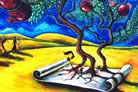 Exploring Jewish Mysticism Through Art: Ascent Retreat Focuses on Re-Creation Exploring Jewish Mysticism Through Art: Ascent Retreat Focuses on Re-Creation
When most people think of Safed, two things immediately come to mind, aside from the city's sheer beauty and vistas, perched as it is atop Israel's Upper Galilee region: Jewish mysticism and art.
|
|
| Israel |
 Adaptive Israel Trip Forges Special Bonds Adaptive Israel Trip Forges Special Bonds
Jesse Frankel, 21, recently returned from a trip he didn't want to end. A participant in a Taglit-Birthright Israel project made possible as part of a partnership between trip provider Mayanot and the Friendship Circle, he spent 10 days touring the Holy Land with his peers.
|
|
| Education |
 Lubavitch's UK Schools on Firmer Financial Footing Lubavitch's UK Schools on Firmer Financial Footing
The organization has seen increasing donations and a change of status for two of its Jewish day schools, the Senior Girls' School in Stamford Hill and the Lubavitch House Boys' School, which allow them to benefit from state funds.
|
|
| Israel |
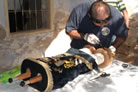 Safed Police Open Synagogue With Recovered Torah Scroll Safed Police Open Synagogue With Recovered Torah Scroll
Deriving inspiration from its role in the recovery of six stolen Torah scrolls, the Safed branch of the Israel Police has established a synagogue in the local police station and arranged for the use of one of the scrolls belonging to the holy city's historic Tzemach Tzedek Synagogue.
|
|
|
|
|
|
Parshat Matot-Massei
Moses conveys the laws governing the annulment of vows to the heads of the tribes of Israel. War is waged against Midian for their role in plotting the moral destruction of Israel, and the Torah gives a detailed account of the war spoils and how they were allocated amongst the people, the warriors, the Levites and the high priest.
The tribes of Reuben and Gad (later joined by half of the tribe of Manasseh) ask for the lands east of the Jordan as their portion in the Promised Land, these being prime pastureland for their cattle. Moses is initially angered by the request, but subsequently agrees on the condition that they first join, and lead, in Israel's conquest of the lands west of the Jordan.
The forty-two journeys and encampments of Israel are listed, from the Exodus to their encampment on the plains of Moab across the river from the Land of Canaan. The boundaries of the Promised Land are given, and cities of refuge are designated as havens and places of exile for inadvertent murderers. The daughters of Tzelafchad marry within their own tribe of Manasseh, so that the estate which they inherit from their father should not pass to the province of another tribe |
| |
|
|
| |
|